
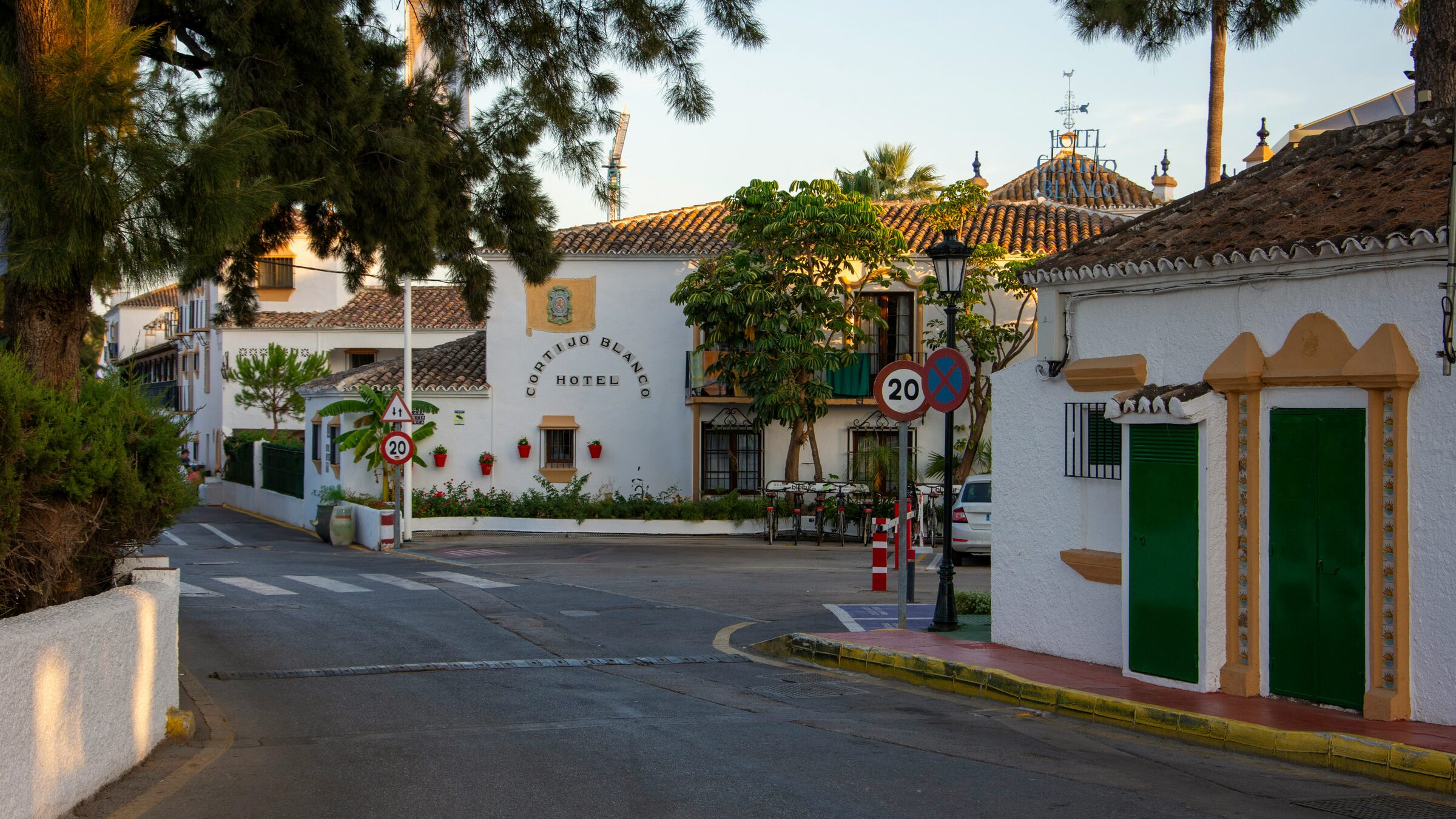
Marbella is safe. That is the honest starting point.
The composite crime index on Numbeo puts Marbella at 53.10 — moderate by European standards, and roughly comparable to established cities like Amsterdam or Barcelona. But when you look at the breakdown, the picture shifts: violent crime scores 46.22 (moderate-low) and attacks score 36.19 (low). The headline composite is pulled up by opportunistic property crime and traffic incidents. Stranger violence is rare.
Nordic buyers sometimes arrive with a vague concern about "Spain" based on general European press coverage. The concern is understandable. The data does not support it for Marbella specifically.
So if Marbella overall is safe, what does "safety" actually mean for a buyer deciding between areas and properties? It tends to mean four distinct things — and they require four different answers.
The Four Dimensions of Safety Buyers Actually Care About
1. Physical security and crime exposure. Which areas have the lowest residential crime rates, and what does gating actually prevent?
2. Gated living and peace of mind. What does "gated urbanisation" mean in practical terms on the Costa del Sol — and is it worth the premium?
3. Investment safety. Which areas hold their value in a downturn, and which carry liquidity risk?
4. Legal and title safety. How do you verify that the property you are buying is legally clean, properly permitted, and not exposed to planning disputes?
The first three are related. The fourth is entirely separate and more important than most buyers realise.
Physical Security: Which Areas Have the Lowest Crime Exposure?
The Golden Mile — the strip from Marbella centre to Puerto Banús — consistently records the lowest residential crime rates in the municipality. The combination of high private security budgets (the major hotels, the Marbella Club, Puente Romano all run their own security corridors), dense CCTV coverage, and a resident profile that is year-round rather than seasonal contributes to a consistently low-crime environment at street level.
East Marbella (Los Monteros, Río Real, Las Chapas) has a similar profile: lower tourist density than central Marbella and Puerto Banús, more permanent residency, and a correspondingly quieter security environment.
Nueva Andalucía sits slightly differently. As a large, dispersed residential zone with thousands of homes spread across the Golf Valley, it has more property crime than the Golden Mile — specifically, opportunistic theft targeting homes left empty during winter months. This is a common pattern in holiday-property heavy zones across the Costa del Sol. It is manageable, and the gated communities within Nueva Andalucía (discussed below) address it directly.
The town centre of Marbella and the Puerto Banús marina area have the most visible security incidents — pickpocketing, opportunistic theft in tourist season. Neither is your target area as a property buyer, and neither presents risk to residential owners.
Gated Urbanisations: What They Actually Are
"Gated community" means different things depending on the urbanisation.
At the top end: Cascada de Camoján on the Golden Mile hillside and La Zagaleta in Benahavís operate with 24-hour manned security posts, biometric or card access, private security patrols inside the perimeter, and in La Zagaleta's case, restricted airspace overhead. These are genuine controlled environments where access for non-residents requires advance authorisation.
Within Nueva Andalucía, the picture is more varied. A number of established gated communities offer meaningful security infrastructure:
Aloha Hill Club is one of the most consistently mentioned by long-term residents for its combination of barrier access, 24-hour security, and maintained common areas. The community sits at elevated position in the Golf Valley with sea views, and has a strong year-round resident base that maintains the urbanisation discipline.
Los Naranjos de Marbella and La Cerquilla operate similar barrier systems. Los Arqueros in the Benahavís foothills provides a mid-market gated option with mountain backdrop.
What "gated" does not automatically mean: CCTV on every internal street, regular patrols, response guarantees. Some urbanisations with barrier access are staffed only in tourist season, or operate with barrier cards rather than guards. When evaluating a gated community, the right questions to ask are:
- Is the security post staffed 24 hours, 365 days, or seasonally?
- Is there CCTV on the perimeter and internal roads?
- Is there a private security patrol inside the gates, or is the barrier the only measure?
- What is the annual community fee, and what percentage covers security?
A well-run gated urbanisation with 24-hour manned security costs more in community fees. That cost is real — but so is the peace of mind for owners who spend six months of the year outside Spain.
Investment Safety: Which Areas Hold Their Value?
This is not the same as crime safety, but buyers who are spending €1M+ naturally think about downside risk.
The 2008 crash is the reference point. Marbella prime — Golden Mile, Sierra Blanca, Cascada de Camoján — fell meaningfully in 2008 but recovered faster than the broader Spanish market, and recovered more completely. The areas that have not fully recovered are the mass-market apartment developments on the eastern Costa del Sol outside the main municipalities. Within Marbella proper, at mid-to-high price points, the 2008 episode produced a painful correction followed by a decade-long recovery that has now produced all-time highs.
The areas with the most investment safety — defined as liquidity and price resilience — are:
Golden Mile. The deepest secondary market on the coast. Correctly priced properties move. The global buyer pool is widest here.
Nueva Andalucía Golf Valley. Strong year-round demand from an international buyer base. Properties in established gated communities with active community management have held value consistently. Apartments near the course frontlines have the most liquidity.
East Marbella is not the deepest liquidity market, but the Four Seasons development at Los Monteros is creating a structural repricing event that provides a clear demand narrative for the next decade.
What carries the most liquidity risk: isolated rural properties, underdeveloped areas with thin transaction history, and properties in urbanisations with high vacancy rates and poor community management.
Legal Safety: The Checks That Actually Matter
This is where most buyers — including experienced ones — underinvest their attention.
Spain has a relatively straightforward land registry system, but it is possible to buy a property that is legally complicated in ways that are not visible to the naked eye. The most common issues:
Illegal additions. A villa with an extended terrace, a converted basement, or a pool house that was built without a building permit and never added to the title. You inherit the liability.
Urban planning reclassification. Properties on the edge of protected zones or in areas with ambiguous planning history can be subject to reclassification disputes. This was more common in post-2000 coastal development — less common within Marbella's Golden Mile and established urbanisations.
Community debt. A property can be free of mortgage and clean in the registry while owing significant unpaid community fees. These debts transfer with the property.
Habitation licence gaps. Some properties — particularly new builds completed in the 2000s — were never issued a first habitation licence (licencia de primera ocupación). This creates complications when registering utilities and, in some cases, when selling.
The four documents a buyer's lawyer must obtain before exchanging contracts:
1. Nota simple from the Land Registry (Registro de la Propiedad). This is the basic title document. It shows who owns the property, what mortgage charges (if any) exist, and any registered annotations or embargoes. It does not cover planning history.
2. Urban planning certificate (informe urbanístico) from the Marbella Town Hall. This confirms the planning classification of the land, what the permitted use is, and whether there are any outstanding planning violations registered against the property.
3. IBI receipts (Impuesto sobre Bienes Inmuebles). Spain's equivalent of council tax. Unpaid IBI becomes a charge on the property, not on the seller personally. Verify the last three years are paid.
4. Certificate of community debts. From the property's homeowners association (comunidad de propietarios). Confirms no outstanding unpaid fees.
In addition: the energy performance certificate (certificado de eficiencia energética) is legally required for any sale. The habitation licence (cédula de habitabilidad / licencia de primera ocupación) should exist for any property built after 2003 — verify it is in order.
Within Marbella's established prime urbanisations — Golden Mile, Sierra Blanca, Cascada de Camoján, Aloha Hill Club, Los Naranjos, Las Brisas in Nueva Andalucía — most properties have clean legal histories. The risk profile increases sharply in rural plots on the outskirts, in urbanisations developed rapidly during 2000–2008, and in any property where the seller is reluctant to provide documents upfront.
A buyer's lawyer in Marbella will run all four checks as standard. If yours is not doing so, find a different lawyer.
The Honest Risk Assessment
The risk of buying in Marbella today is not zero. Some illegal builds still exist on the broader Costa del Sol. Title issues surface occasionally. Community debt disputes happen.
But the risk is concentrated in specific areas and specific circumstances: underdeveloped zones, opaque sellers, properties priced meaningfully below market without clear explanation, and situations where the buyer's lawyer has not been given time and access to do proper due diligence.
Within the established prime areas — Golden Mile, Nueva Andalucía Golf Valley, Benahavís gated communities — buying with a competent buyer's lawyer and a buyer's agent who knows the market produces a manageable, well-understood risk profile. Not zero. But comparable to buying prime property in any established European market.
The structural change since 2008 is significant: Marbella's planning department has tightened considerably, the documentation trail on properties is far better than it was two decades ago, and the international buyer base has professionalized the market. The wild west era of Marbella real estate is not the current market.
What to Check Before You Buy: An 8-Point Summary
- Nota simple — who owns it and what charges exist?
- Urban planning certificate — what is the planning classification and are there any violations?
- IBI receipts — are the last three years paid?
- Community debt certificate — is the property clear with the homeowners association?
- Habitation licence — does it exist and is it current?
- Energy performance certificate — present and in order?
- Illegal additions — do built structures match what is registered on the title?
- Gated community security — is it 24/7 and what is the actual security model?
A buyer's agent and a buyer's lawyer working together should make this process manageable. If either role is missing from your purchasing team, the oversight risk increases substantially.
If you have questions about a specific area or a specific property's legal status, I'm happy to talk through what the due diligence should look like.
Erlend Sand is the founder of Marbella Agency. He is Norwegian, lives in San Pedro de Alcántara, and has worked exclusively in the Marbella west end for several years. He writes from direct personal experience as both a buyer and an adviser in this market.